

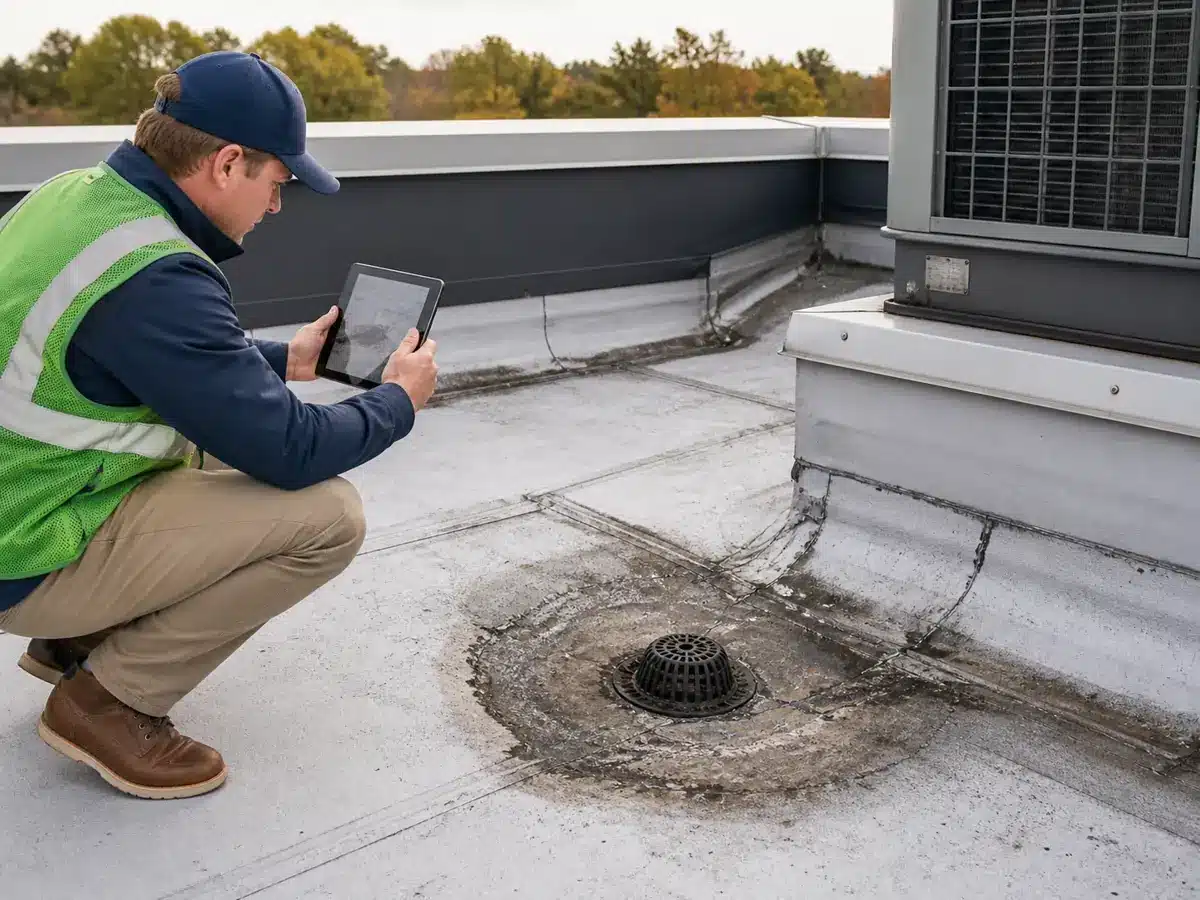
03 Sep How Often Should a Commercial Roof Be Inspected?
Quick Answer
Industry guidance, including inspection and maintenance recommendations published by the National Roofing Contractors Association (NRCA), commonly calls for inspecting a commercial roof at least twice a year, typically in spring and fall, plus after major weather events. Roof age, type, condition, and rooftop traffic can shift that schedule, which is why many owners confirm the right cadence with an independent consultant.
That is the industry baseline. The right schedule for your building depends on the roof you actually have — its age, its type, its history, and what sits on top of it. This guide walks through the common schedules, the factors that change them, and how to build an inspection habit that protects your budget instead of straining it.
Why Inspection Frequency Matters for Budgets
A commercial roof rarely fails all at once. It fails in small, quiet steps: a seam that opens slightly, a flashing joint that pulls away, a drain that clogs and lets water pond. Caught early, most of these are modest repair items. Left alone, water works into the insulation and deck, and the conversation shifts from a repair line item to a capital project.
Inspection frequency is the control you have over that timeline. A roof reviewed on a regular schedule gives you three things a neglected roof cannot: early warning while problems are still small, a documented condition history you can plan reserves against, and a defensible record when a board, owner, or finance team asks why money should be spent now rather than later.
For property managers and HOA boards, that third point is often the decisive one. Reserve planning, capital budgets, and board approvals all run on documentation, and “the roof was inspected on schedule, and here is what each visit found” is the sentence that makes a roofing line item defensible. The schedule itself becomes part of your governance record — evidence that the building was managed, not merely repaired.
Alliance Consulting & Testing has performed independent inspections on 75,000+ roofs covering 250 million+ sq ft over 25+ years. We do not sell roofs. We help you understand yours — which means our only interest in your inspection schedule is that it fits your building, not a sales pipeline.
Factors That Change Your Inspection Schedule
Twice a year is a starting point, not a rule. These factors move the number up — and occasionally down.
Roof Age, Type, and Condition
A roof in its first years of service with no known issues can usually follow the baseline schedule. As a roof moves past mid-life, more frequent reviews make sense: aging membranes, brittle sealants, and past repairs all deserve closer watching. A roof with a known problem area — recurring ponding, a patched leak, a section of suspect insulation — may warrant additional condition checks until the issue is resolved or the repair-vs.-replace question is settled. Roof type matters too: different membrane systems age differently, and each has its own common failure points an inspector will track over time.
Condition history matters as much as age on paper. Two roofs installed the same year can sit in very different places on the risk curve depending on installation quality, drainage performance, and how past repairs were made. If you do not know where your roof sits, that is itself a reason to inspect: the first independent inspection establishes the baseline every later scheduling decision builds on.
Weather Exposure and Rooftop Traffic
Climate does real work on a roof. Hail, high winds, heavy snow loads, and freeze-thaw cycles all justify a look after the event, not just at the next scheduled visit. So does rooftop traffic: buildings with frequent HVAC service, satellite or solar equipment, or trades walking the roof see more punctures, crushed insulation, and damaged flashings than buildings no one visits. If your roof is a work platform for other vendors, inspect it more often — and after any significant rooftop work. Regional climate shapes the calendar as well: in hail- and wind-prone areas, the after-storm check does much of the protective work, while in snow country the spring visit catches what freeze-thaw cycles opened over winter.
Scheduled Inspections vs. Event-Driven Inspections
A sound program uses both.
- Scheduled inspections are calendar-based — commonly spring and fall — and exist to catch gradual wear before it becomes intrusion. They build the documented history that supports budgeting and lifecycle planning.
- Event-driven inspections respond to something specific: a major storm, hail or wind damage nearby, work performed on the roof by another trade, an upcoming warranty milestone, a property purchase or sale, or interior warning signs such as stains or musty odors.
Event-driven inspections earn their cost in documentation as much as detection. An inspection dated to the event creates a clear before-and-after record, which keeps responsibility conversations — with vendors, boards, and anyone else — grounded in evidence instead of memory.
One important distinction: an event-driven look prompted by active water intrusion is not the same engagement as a routine inspection. It is a targeted diagnostic with a different scope and outcome. We explain the difference in annual roof inspections vs. leak investigations.
Building an Annual Inspection Habit
The owners and managers who avoid roof surprises tend to do the same simple thing: they put inspections on the calendar and keep the reports. An annual (or semi-annual) habit gives you a year-over-year condition record, a prioritized repair list instead of an emergency scramble, and cleaner capital planning because replacement timing stops being a guess.
Who performs those inspections matters as much as whether they happen. A schedule kept by the company that sells the repairs will always carry a question mark; a schedule kept by an independent consultant produces findings no one has to discount.
If you want to see what a thorough review actually covers before you schedule one, start with the commercial roof inspection checklist. For the full picture of how inspections fit into owner-side decision-making, read the independent commercial roof inspection guide.
Set a Defensible Inspection Schedule — Schedule a Call
Every building is different, and the right cadence is a judgment call worth making once, deliberately, with someone who has no stake in what the inspection finds. Alliance is the owner’s independent roof expert: no roof sales or installations, just unbiased consulting to help you make informed decisions.
Schedule a Call to talk through your building, or call 888-777-7001.
FAQs
Is twice a year really necessary?
For most commercial roofs, twice a year is the commonly cited industry baseline because it brackets the harshest seasons — you check condition after winter and again before it. Some low-risk roofs are reviewed annually; older roofs, problem roofs, and high-traffic roofs often justify more. The point is a deliberate schedule, not a fixed number.
Should I inspect after severe weather?
Yes. Hail, high winds, and heavy snow can cause damage that is not visible from the ground and does not leak immediately. A post-event inspection documents the roof’s condition while the timeline is clear, which helps you separate storm damage from ordinary wear and act before water finds its way in.
Does a new roof need inspections?
It does. Early reviews establish a baseline condition record, catch installation-related issues while they are easiest to address, and support the maintenance documentation many owners keep alongside their warranty records. Skipping inspections because a roof is new is how small defects get years to grow.
What happens if a roof goes years without inspection?
Nothing — until something. Uninspected roofs tend to convert small, cheap repairs into saturated insulation, deck damage, and interior disruption, and they leave owners with no condition history when the repair-vs.-replace question finally arrives. The first step back is simple: one independent inspection to establish where the roof actually stands.

Bill Harris, RRO, is President and Senior Consultant at Alliance Consulting & Testing. Since 2007, he has led roof consulting, roof condition analysis, roofing specification writing, and quality assurance for building owners and property managers. His credentials include Registered Roof Observer, Haag Certified Inspector, RCI/IIBEC involvement, ASTM Roofing and Waterproofing Committee participation, and extensive national project experience.